






What a mini split tune-up covers in Oregon

A local pro who services mini splits gets in touch about the tune-up.

Find my pro

A mini split tune-up covers the same ground whether you've got one head or a whole house of them: the contractor cleans the indoor filters and coil, checks the outdoor unit's coil and fan, confirms the refrigerant charge, and tests that each zone actually calls for heat or cool and gets it. Mini splits move heat rather than burn fuel for it, so a dirty coil or a filter clogged with dust makes the system work harder to move the same amount of air, and that shows up on your electric bill since most homes in Oregon heat with electricity already carried through these units. Because your mild summers mean these systems often run more for heat than cooling, the tune-up usually happens before fall, when you'd rather find a weak part on a mild afternoon than discover it on the first cold night. For a reader planning a season ahead, this is the one chance to catch a failing part while it's still just a line item, not a no-heat call.

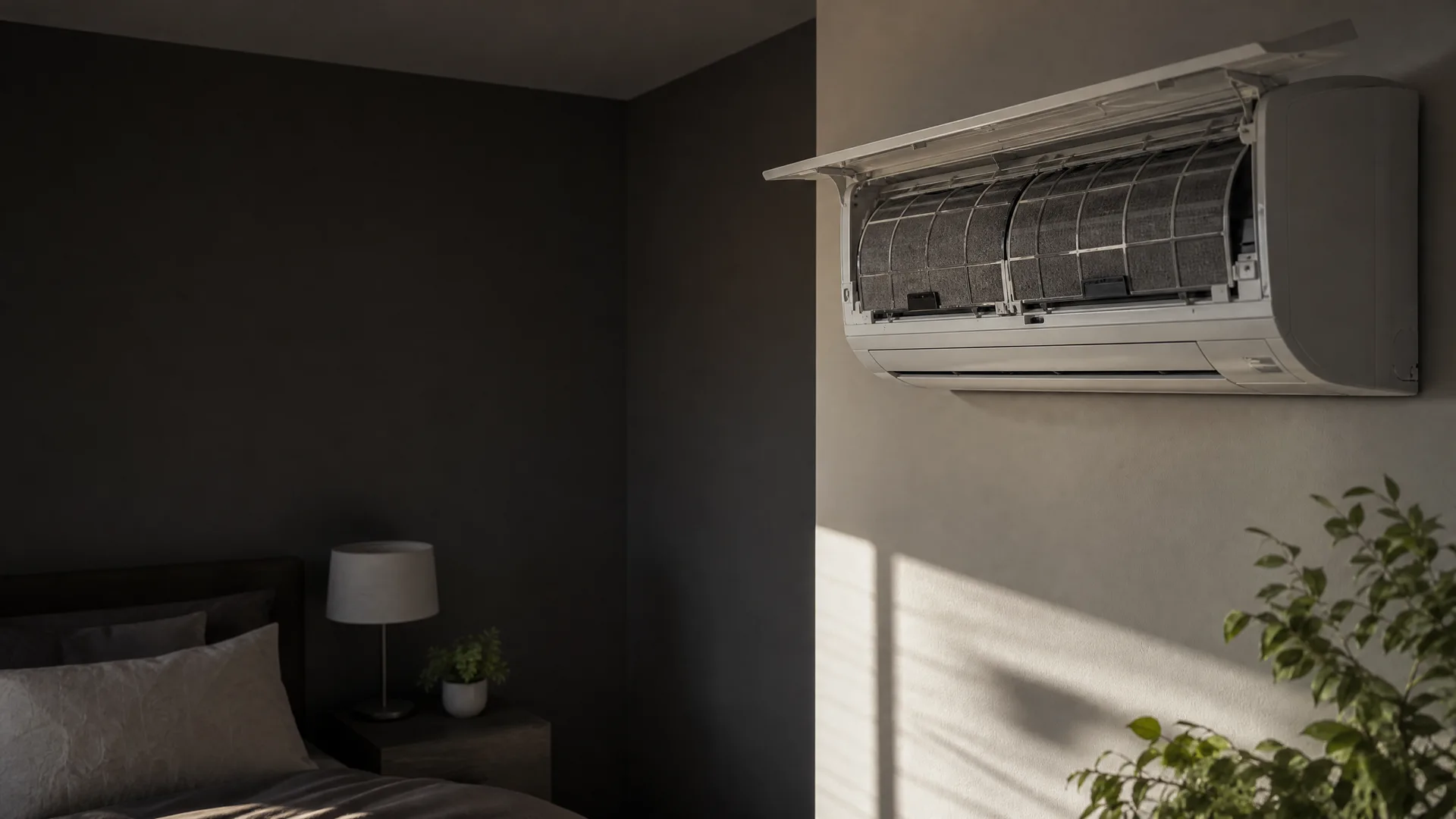
A wall-mounted mini-split air conditioner with its front cover open exposing the filters, in a dim bedroom with a bed, nightstand lamp and a potted plant.

You pop the front cover off the bedroom unit on a Saturday in April, the window cracked to that first warm, dry air of the year. The filter screen looks like it's wearing a coat of grey felt. You hadn't opened this thing since last fall. Behind it, the coil fins are dusty too, the kind of dust you can't see from across the room but can't miss up close. You run a finger along the screen and it comes away grey. This is the unit that handles your bedroom all summer, every summer, and you're only now seeing what's been sitting behind that plastic cover since October.

What does the contractor actually check on the outdoor unit?

You've seen the indoor head get opened up and cleaned, but that outdoor unit sitting against the house hasn't been touched since it was installed. It runs in the rain, the heat, whatever Oregon throws at it all year, and you're not sure what a contractor is actually looking at out there versus just a quick glance and a nod.

The contractor checks the coil, the fan, and the refrigerant lines

The outdoor coil sits behind a metal grille, and over a year it collects cottonwood fluff, grass clippings, and whatever else blows through your yard. A contractor clears that off so the unit can shed heat properly in summer and pull heat from the outside air in winter, since your mini split is likely doing both jobs for you. They check that the fan spins freely and isn't grinding on a bent blade or a failing bearing. They look at the refrigerant line set for oil residue, which points to a slow leak, and check that the lines are still wrapped and insulated where they run to the house. A unit that's been fighting a dirty coil for a season runs longer to do the same job.

A woman with long gray hair wrapped in a checked blanket sits on a sofa by a window with yellow autumn foliage outside, with a lamp, framed picture and plant in the background.
An older woman in a cream knit sweater sits on a sofa by a window, looking out at sunlit trees with yellow and orange autumn leaves, with a bookshelf and lamp behind her.
A woman with gray shoulder-length hair in a dark knit sweater sits on a cushioned seat by a window, looking out at yellow autumn foliage, with a living room, armchair, houseplant and framed picture behind her.
An older woman with gray hair in a bun, wearing a cream knit sweater, sits on a sofa with a gray blanket and looks out a large window toward yellow-green autumn trees, with a lit table lamp and dark armchair behind her.

Get your mini split to the right pro

Fill out one form instead of calling around for a mini split tune-up.

No fee to send it, and nothing to sign.

Why each zone gets checked

A mini split is really several systems sharing one outdoor unit, and they don't always age the same way. The head in the bedroom you run every night during a warm stretch wears different than the one in a guest room that barely gets touched. A tune-up tests each zone on its own, checking that the one you use most still pulls down a room as fast as it used to. If one head is weak, it can sit right next to a strong one and you'd never know without the contractor running them both.


What the filter has to do

The filter in a mini split head isn't paper like a furnace filter. It's a washable mesh screen, and it sits right where air gets pulled in before crossing the coil. In a house heating with electricity, that head is working through more of the year than a typical AC unit would, which means more hours for dust to build on that screen. A clogged filter makes the unit work harder to move the same air, and it's the one part a contractor cleans on every single visit, no exceptions.

A white wall-mounted mini-split air conditioner indoor unit installed near the ceiling on a plain light-colored wall, with its horizontal outlet vent and louvers visible.
Before you get your mini split maintenance
A white wall-mounted mini-split air conditioner on a beige interior wall, with a curtained window on the left and wood flooring with a light rug below.
After you get your mini split maintenance
A white wall-mounted mini-split air conditioner on a beige interior wall, next to a window with sheer white curtains and green foliage outside.

Running clean

Air moves out of the head without effort, and the room gets to temperature without the unit running long stretches to do it. The vents stay free of dust, the coil behind the filter stays pale and dry, and nothing drips or smells musty when it kicks on.

A dusty, discolored wall-mounted mini-split air conditioner indoor unit on a plain white wall, with its horizontal louvers and vent grille visible.

Caked with grime

The top surface and vents are coated in a gray film you can see from across the room. Air still comes out, but it carries dust with it, and the unit works harder to move the same amount of air through a coil that's clogged behind the screen.

Why is the air from your mini split weaker than it used to be?

You notice it most on the first warm day, when you want the bedroom head running and it just doesn't pull the room down the way it did last year. The airflow feels thin even at full fan speed. Up close, the vents have a thin layer of dust on the louvers, and the room you run most, the one you actually sleep in during a warm stretch, might be the one struggling hardest. If you catch a musty smell when it kicks on, that's water sitting somewhere it shouldn't. Left alone, a dirty filter or coil makes the unit run longer to do the same job, and since most homes here heat with electric, that same head is working through winter too. A clogged drain can back up and leak onto the wall or floor below it.

A white wall-mounted mini-split indoor unit installed high on a gray interior wall, with a sofa, dark table and window visible in an adjoining room to the right.
A clean coil, a clear filter, air coming out strong enough to push a sheet of paper off the louver.
A wall-mounted mini-split air conditioner indoor unit with a dusty beige casing and dark louvered vent, installed near the ceiling on a plain beige wall.
Yellowed casing, dust packed into the vents, and a coil underneath that's been collecting it for longer than one season.

Power costs 15.46 cents per kilowatt-hour statewide

Since most Oregon homes heat with electricity, your mini split is doing double duty, and at 15.46 cents per kilowatt-hour, a dirty filter or low charge that makes it run longer shows up on every winter bill, not just the summer one.

EIA-861 2025 statewide residential average

A woman in a cream knit sweater sits in an armchair with her eyes closed and a slight smile, beside an open window showing orange autumn foliage, with a mug, books and a lit candle on a small side table.
An older man with gray hair and a beard leans back on a beige sofa with his eyes closed, in a sunlit room with potted plants, a wicker chair and large windows behind him.
A woman in a cream cardigan and jeans stands with one hand raised facing an open front door of a gray horizontal-siding house, with a black lantern wall light, a potted shrub with yellow flowers, and a stone-faced porch column.

What a tune-up on your mini split comes down to

A tune-up on your mini split means someone checks the filters, the coils, the outdoor fan, and the charge, zone by zone, before the weather asks anything of the system. That's the whole answer. You now know what should get touched and why it matters for the months ahead.

Finding someone to do that work is a different task than knowing what it involves. You'd still need to find a contractor who services mini splits in your area, call around, describe your setup more than once, and sort through quotes that don't line up. Submit your information here instead, and a contractor who works on systems like yours gets matched to your situation and reaches out to you directly. You stay the person who knows what the tune-up should cover. Someone else handles the rest of the season ahead.

A living room corner with a light beige sofa holding a textured taupe cushion, a large ceramic vase of olive branches by a window, a framed neutral artwork on the wall, and a dark bowl with stacked books in the foreground.
A white wall-mounted mini-split air conditioner on a dark gray interior wall above a gray sofa, with a window and curtain at left, a potted olive-like plant at right, and a black vase and bowl on a table in the foreground.

The right pro for this job

Fill out one short form instead of calling around.

Step 1 of 3: Equipment








