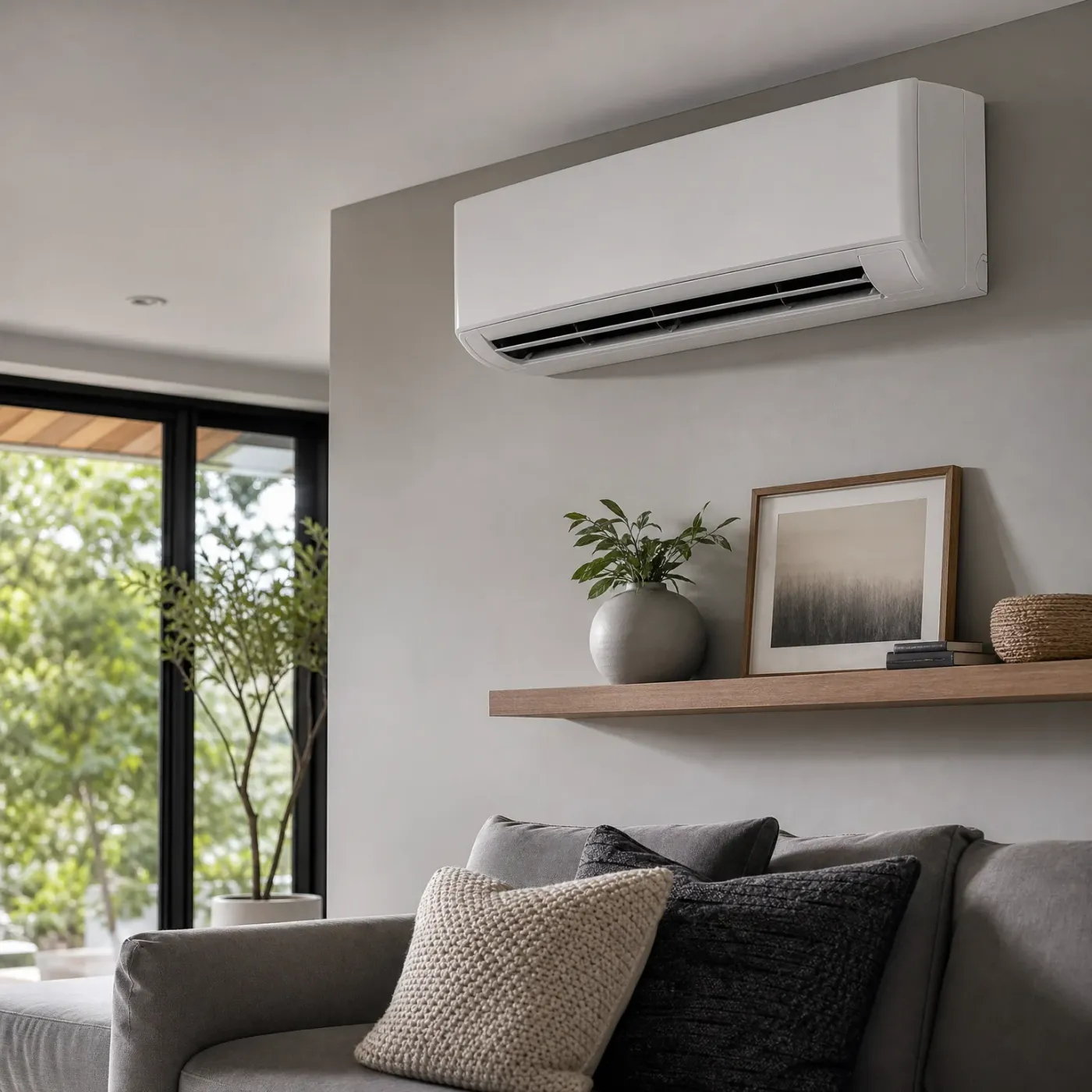
A white wall-mounted mini-split air conditioner on a dark gray interior wall above a framed picture, with a potted plant and curtained window to the right.

A local pro for your mini split repair

Why your mini split won't turn on in an Oregon winter

A mini split that won't power on in the middle of an Oregon winter usually comes down to a short list of causes, from a tripped breaker to a frozen outdoor unit to a failed control board. This page walks through what to check and what it means. If you'd rather have someone look at it, you can get matched with a local contractor who works on these systems all winter.

Find my pro

A mini split that won't turn on in winter is usually either not getting power or not getting a signal to start. Start with the breaker. A mini split draws hard on cold mornings when it's working hardest to pull heat out of freezing air, and that load trips a weak breaker. If the breaker's fine, look at the outdoor unit. If it's caked in ice or snow, the system may be locking out on purpose to protect itself rather than run against a blocked coil. Check the remote's batteries and the display on the indoor head for a blinking light or code, since most units show some kind of fault signal rather than just sitting dead. If the breaker holds, the unit's clear, and nothing on the display responds at all, the control board itself may have failed. That's not something to keep testing blind in the cold. It needs someone who can read what the unit's telling you and knows which of those causes shows up most this time of year.

A white wall-mounted mini-split air conditioner on a beige interior wall, with a cream curtain and window at left, a potted plant on a ledge at right, and a wood floor below.
A mini split like this is getting power and responding to the thermostat, cycling on when the room calls for heat.
A dusty, discolored white wall-mounted mini-split air conditioner unit installed high on a plain interior wall below a white ceiling molding.
A coil and filter this dirty make the outdoor or indoor unit work harder, and a unit already struggling is more likely to trip out in cold weather.

Cold weather makes the outdoor unit work in a way summer never does. Every so often it reverses itself for a few minutes to melt frost off the coil, and while that's happening the indoor fan goes quiet and the display may flash a frost symbol. That's normal. It's not normal when the coil stays caked in ice after defrost ends, which usually means snow, fallen debris, or a drain pan that's frozen underneath the unit and can't clear. Inside, the system reads what's happening through a sensor wired to a control board, and if moisture gets into that board or shorts a connection, the unit won't start no matter what the thermostat says. If it starts and then drops out during a cold snap, a limit switch may be cutting power because the compressor is pulling more amps than the board will allow. And some systems are built to stay off below a certain outdoor temperature until a base pan heater or crankcase heater brings the unit up to a safe operating range first. None of this is a guess. It's the order these systems are designed to work in.

How the unit actually fails

  • The outdoor unit runs a defrost cycle on its own, reversing briefly to melt frost off the coil before it can start heating again.
  • During defrost the indoor fan usually stops and the display may show a frost or defrost symbol instead of a fault code.
  • An outdoor unit caked in ice beyond what defrost clears is often blocked by snow, debris, or a drain that's frozen shut underneath it.
  • A mini split signals its controller through an indoor sensor and a control board, and a short or moisture there can stop the unit from starting at all.
  • Short cycling off during a cold snap usually means a limit switch has caught the unit pulling more amps than the board will allow.
  • Some systems lock out heating below a set outdoor temperature until a base pan heater or crankcase heater warms the unit enough to run safely.
A dusty beige wall-mounted mini-split air conditioner indoor unit installed high on a plain light-colored wall below the ceiling.
Before you get your mini split repair
A white wall-mounted mini-split air conditioner near the ceiling of a room with light gray walls, white crown molding, and a beige curtain at the left edge.
After you get your mini split repair

Why the outdoor unit matters most

The outdoor unit is doing the harder job all winter. It has to pull heat out of air that might be near freezing, and the colder it gets outside, the more it has to run to keep up. That is why problems show up there first. Ice on the coil, a fan that is not turning, or a compressor that hums but will not start all point to the outdoor unit struggling under a load the indoor head never sees. If the indoor head lights up but the room stays cold, the outdoor unit is usually where to look.

What a breaker trip tells you

A breaker that trips once on a cold morning and resets fine might just be a hard start on a hard day. A breaker that trips again within a day or two is telling you something is pulling more current than it should, maybe a failing compressor or a short somewhere in the line. Resetting it again and again without finding out why risks damage that costs more to fix than the original problem. One trip is worth watching. A second one is worth having someone look at before you flip it back a third time.

A woman with long blonde hair in a light blue shirt leans back on a beige sofa with her eyes closed, in a softly lit living room with cushions and a blurred plant and shelf in the background.
A woman with long dark hair in a gray knit sweater sits on a gray sofa with a cushion, looking toward a window in a living room with framed pictures and a lamp in the background.
A woman with long dark hair in a light grey knit sweater sits on a sofa indoors, looking to her right, with a framed landscape picture, a potted plant and a curtained window behind her.
A woman with long dark hair leans back against a gray sofa with her eyes closed, in a living room with a curtained window, a potted plant, and a dark screen in the background.
A white wall-mounted mini-split air conditioner near the ceiling of a living room with a gray sofa, knit cushions, a wooden floating shelf holding a plant in a round vase, a framed print and a woven basket, and a large window showing green trees.

Get the right pro for your mini split

The pro who reaches out is licensed in Oregon.

Tell a local repair pro what your mini split is doing.

Find a licensed pro

There's no charge for the request.

Why does my mini split just blink at me and not start?

A blinking light with no heat is one of the more confusing ways a mini split fails, because the unit is clearly doing something, just not the thing you need. You go to the wall, look up at the indoor head, and see a light flashing back at you instead of warm air coming out. It feels like the unit is trying to tell you something, and it is.

The blinking is an error code, counted out in flashes

Most mini splits don't have a screen that spells out what's wrong. Instead the indoor unit's light blinks a set number of times, pauses, then repeats the same count. That pattern is a code the manufacturer assigns to a specific fault, like a communication failure between the indoor and outdoor unit, a blocked drain, or a sensor reading that's out of range. The count means something different on a Mitsubishi than it does on a Fujitsu or a Daikin, so the same blink pattern can point to two different problems depending on the brand. The owner's manual usually has the chart. Without it, the blinking only tells you that the unit caught a problem and stopped itself, not what the problem is.

An older woman with short gray hair in a cream cable-knit turtleneck sweater smiles while looking to the side in a wooden kitchen, with a round loaf of bread on a board in the foreground and a lit candle by a dark window.
A woman with dark hair in a bun sits wrapped in a chunky knit blanket on a couch with a child resting his head on her shoulder, eyes closed, beside a lit lamp and bookshelf indoors.

If your mini split won't start, the room it heats has no backup. No furnace kicks in, no baseboard heater picks up the load, just the cold settling in while everyone's home.

A frozen coil or a tripped breaker doesn't fix itself overnight, and the longer it sits, the colder that room gets. Get it looked at before it's the only heat source you're missing.

Power costs 15.46 cents per kilowatt-hour statewide

At 15.46 cents a kilowatt-hour, running a mini split is not what's driving your bill up when it won't start. A unit stuck cycling on a tripped breaker or icing over isn't heating the room at all, so the people in it are cold while you're still paying to find out why.

EIA-861 2025 statewide residential average

Where this leaves you

  • A dead mini split in winter usually traces back to a tripped breaker, a frozen outdoor coil, or a control board that stopped responding.
  • Checking the breaker and the outdoor unit for ice takes a few minutes and rules out the two most common causes before anything else.
  • A unit that keeps tripping its breaker or won't clear frost on its own has a problem a homeowner can't fix from the inside.
  • A local contractor who services mini splits all winter has usually already seen whatever is keeping yours from starting.
  • Getting matched with one licensed contractor instead of several means one call back, not a string of them while your house stays cold.
  • The room that mini split heats has no backup, so the sooner the cause gets found, the sooner the cold stops settling in.

A mini split that won't start in an Oregon winter almost always comes down to one of three things: power isn't reaching it, ice has taken over the outdoor coil, or the control board stopped responding to the thermostat. You can check the first two yourself. The breaker takes a glance. The outdoor unit takes a walk outside to see if it's coated in ice that hasn't cleared on its own. Past that point, there's not much more to check from inside the house. A board that won't respond or a coil that keeps icing over despite defrost cycles running is a job for someone who can get into the unit itself.

That's where a local contractor earns their keep. Someone who services mini splits through an Oregon winter has already run into whatever is keeping yours from starting. They've seen the breaker that trips every cold snap because of a compressor drawing too hard, the coil that won't clear because a sensor failed, the board that locks up after one too many power blips. None of that is a guess for them by the time they get to your unit.

Getting matched means one contractor calls you back, not three or four competing for the job while your house sits cold. That's one conversation, one visit, one person who already has a sense of what they're walking into. The room that mini split heats doesn't have a backup heater waiting to pick up the slack, so the sooner someone qualified looks at it, the sooner the cold stops being the thing you're managing around.

A dimly lit room with a dark gray wall holding a white wall-mounted mini-split air conditioner near the ceiling, with a sofa, table lamp, potted plant, and curtained window at left.

A pro who works on mini splits

Only one pro gets your request, so you hear from one company.

Step 1 of 3: Equipment